भगवद्गीता
Bhagavad Gītā
श्रीमद्भगवद्गीता - The Song of God
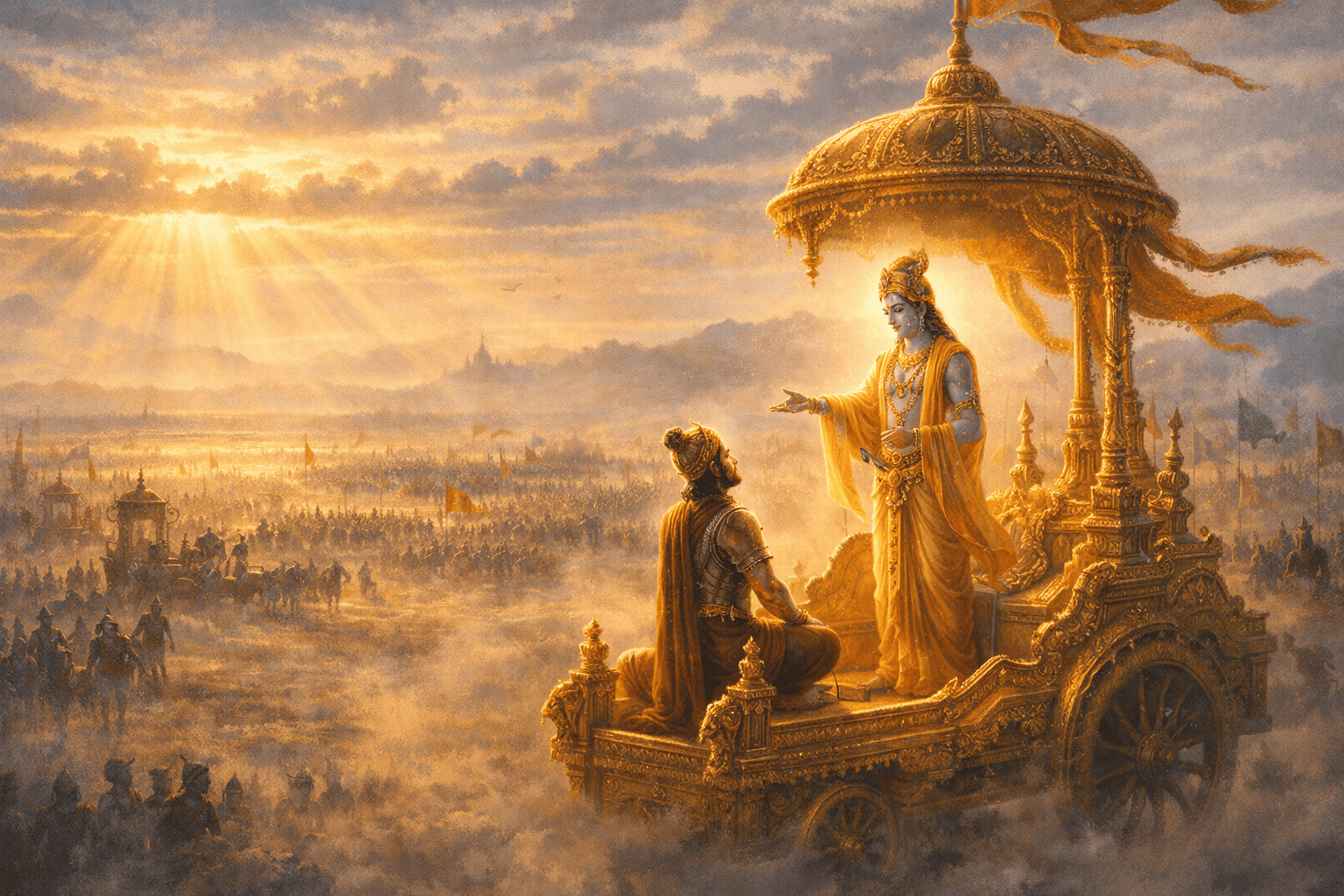
A 700-verse dialogue between Lord Krishna and Arjuna on the battlefield of Kurukshetra. The Bhagavad Gita is a timeless guide to life, covering philosophy, ethics, and spirituality across 18 chapters.
Thematic Overview
The Bhagavad Gita covers six major themes that encompass all aspects of spiritual life and self-realization.
Knowledge & Wisdom
Understanding the eternal soul and supreme reality
Chapters: 2, 4, 7, 13
Devotion & Love
The path of bhakti and surrender to Krishna
Chapters: 9, 12
Action & Duty
Karma yoga and selfless service
Chapters: 3, 5, 18
Meditation & Yoga
Mind control and spiritual practice
Chapters: 6
Divine Nature
Krishna's glories and universal form
Chapters: 10, 11
Philosophy
Metaphysics and spiritual principles
Chapters: 1, 8, 14, 15, 16, 17
Content Analysis
The radar chart shows thematic coverage across different domains. The bar chart displays shloka distribution across all 18 chapters.
Six domains of spiritual knowledge covered in the Gita.
Number of shlokas in each of the 18 chapters.
Loading chart...
The Eighteen Chapters
अर्जुनविषादयोगः
Arjuna Viṣāda Yoga
Arjuna's crisis on the battlefield, where he sees his relatives and teachers arrayed for war and loses the will to fight.
Begin Chapterसाङ्ख्ययोगः
Sāṅkhya Yoga
Krishna begins his teachings, explaining the nature of the eternal soul, the importance of duty, and the path of selfless action.
Begin Chapterकर्मयोगः
Karma Yoga
The path of selfless action, performing duties without attachment to results, as exemplified by ancient sages.
Begin Chapterज्ञानकर्मसंन्यासयोगः
Jñāna Karma Sannyāsa Yoga
Krishna reveals his divine nature and explains the path of knowledge, action, and renunciation.
Begin Chapterकर्मसंन्यासयोगः
Karma Sannyāsa Yoga
The distinction between renunciation of action and renunciation in action, emphasizing the superiority of Karma Yoga.
Begin Chapterध्यानयोगः
Dhyāna Yoga
The practice of meditation, control of mind and senses, and the characteristics of a yogi.
Begin Chapterज्ञानविज्ञानयोगः
Jñāna Vijñāna Yoga
Krishna explains his divine nature, the material and spiritual energies, and how to attain him.
Begin Chapterअक्षरब्रह्मयोगः
Akṣara Brahma Yoga
The nature of Brahman, the process of leaving the body, and the paths leading to liberation.
Begin Chapterराजविद्याराजगुह्ययोगः
Rāja Vidyā Rāja Guhya Yoga
The most confidential knowledge - Krishna's relationship with all beings and the path of devotion.
Begin Chapterविभूतियोगः
Vibhūti Yoga
Krishna reveals his opulences and divine manifestations in the material world.
Begin Chapterविश्वरूपदर्शनयोगः
Viśvarūpa Darśana Yoga
Arjuna beholds Krishna's universal form, seeing all beings, time, and the entire universe within him.
Begin Chapterभक्तियोगः
Bhakti Yoga
The path of devotion, the characteristics of devotees, and the means to attain Krishna.
Begin Chapterक्षेत्रक्षेत्रज्ञविभागयोगः
Kṣetra Kṣetrajña Vibhāga Yoga
The distinction between the body (field) and the soul (knower of the field), and the nature of material nature.
Begin Chapterगुणत्रयविभागयोगः
Guṇa Traya Vibhāga Yoga
The three modes of material nature (sattva, rajas, tamas), their characteristics, and how to transcend them.
Begin Chapterपुरुषोत्तमयोगः
Puruṣottama Yoga
The analogy of the banyan tree, the nature of the Supreme Person, and the path to the eternal abode.
Begin Chapterदैवासुरसम्पद्विभागयोगः
Daivāsura Sampad Vibhāga Yoga
The characteristics of divine and demoniac natures, and the consequences of each path.
Begin Chapterश्रद्धात्रयविभागयोगः
Śraddhā Traya Vibhāga Yoga
The three types of faith, food, sacrifice, austerity, and charity according to the three modes.
Begin Chapterमोक्षसंन्यासयोगः
Mokṣa Sannyāsa Yoga
The final chapter, summarizing all teachings and emphasizing the path to liberation through devotion, knowledge, and selfless action.
Begin Chapter